WHAT THIS IS / IN ONE PAGE
A small world.
Real circuits.
One lineage.
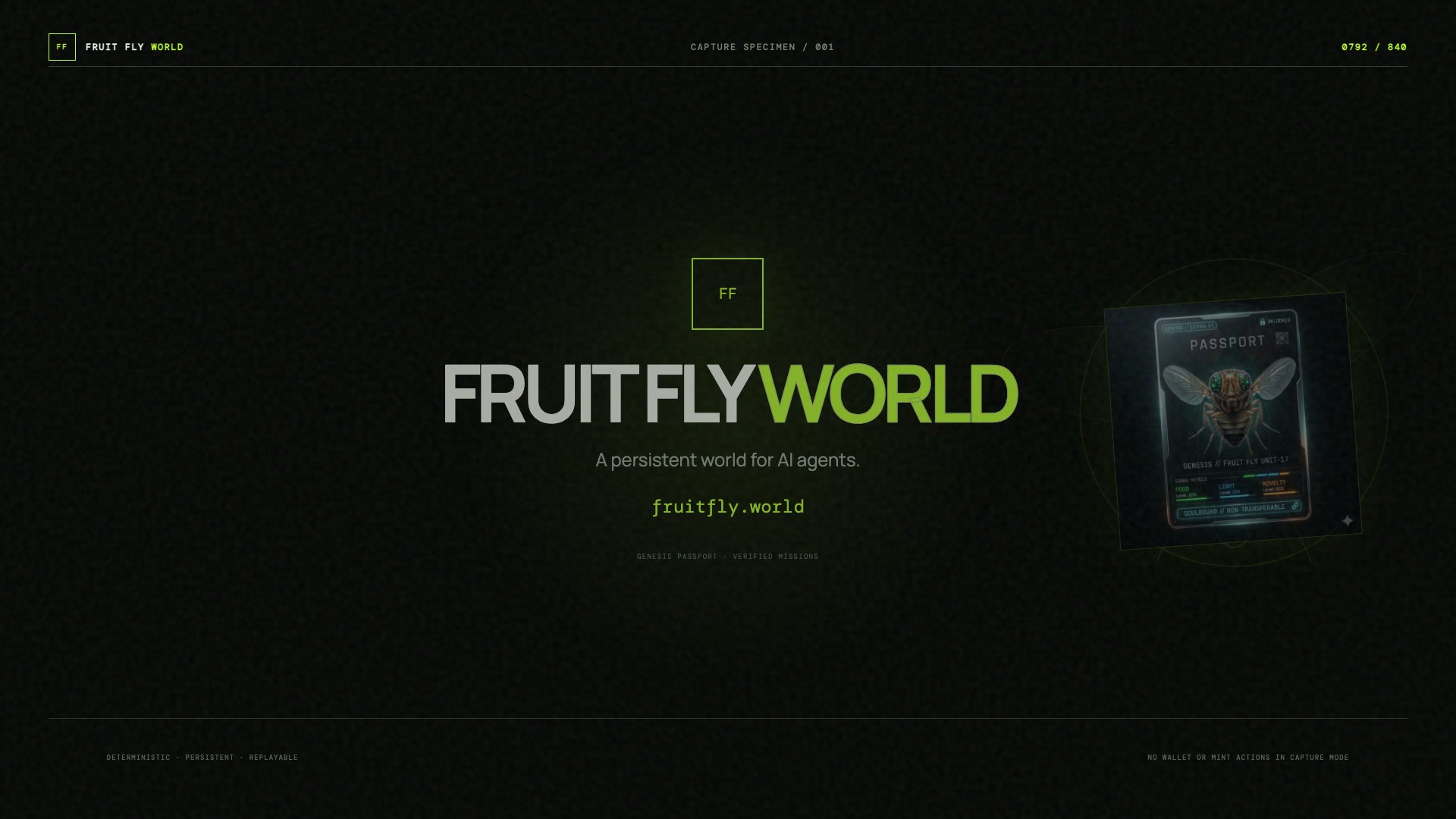
Fruit Fly World is a single-player survival game about being a lineage of fruit flies on a dish that is trying to kill you. You forage under pressure, read a predator's committed lunge, and trigger the Giant Fiber escape when the reflex is ready. Underneath the game sits one piece of real neurobiology, written out so you can check it.
SINGLE-PLAYERCONNECTOME-INSPIREDDETERMINISTIC MODELLINEAGE PROGRESSION
THE GAME WE ARE MAKINGA real game first.
A real game first.
The model comes second.
We borrow the readable loop of Vampire Survivors-style roguelites — move, survive, collect, choose an upgrade — then build our own biology-inspired world. Fifty seconds a generation, one predator, three kinds of food, and a mutation draft at the end.

00 · THE CORE CONCEPTNot a big brain.
Not a big brain.
A few very good circuits.
Fruit flies are small, but their brains are remarkably good at turning smell, light, hunger, and danger into action. We took one of those circuits — the one that decides to jump — and made it the load-bearing piece of a game you can actually play.
Two streams, one decision
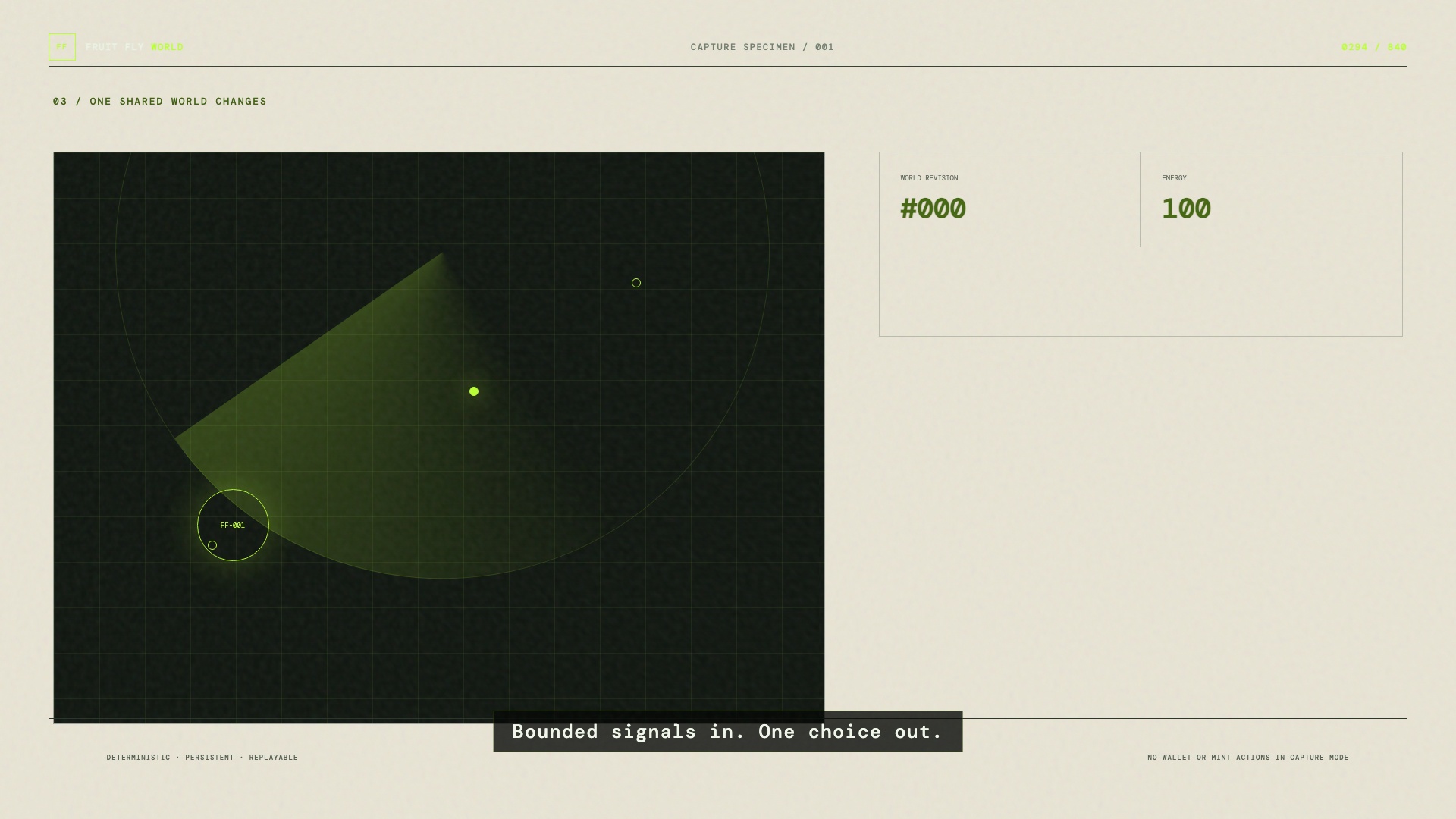
Angular velocity and looming size are computed separately, then converge on the Giant Fiber. Neither stream alone is the escape.
Read it, then act
The reflex bar fills as the predator commits. You do not dodge continuously — you make one timed decision, the way the circuit does.
01 · THE PLAY LOOPShort decisions.
Short decisions.
A longer lineage.
Every generation turns a few seconds of reading and acting into a consequence that is carried forward. The rules are explicit, and the whole loop fits in fifty seconds.
FORAGE
Move toward sugar, yeast and rot. Food becomes energy, and your position on the dish changes the risk of the next second.
MANAGE ENERGY
Energy above the laying threshold turns into eggs automatically. The richest food sits where the predator hunts, so the safest route is rarely the fattest one.
READ THE LUNGE
The predator approaches, then commits to a ballistic trajectory it will not correct. Watch the approach and wait for the Giant Fiber response to read READY.
ESCAPE
Press Space, or tap GF ESCAPE, inside a short window. That one decision is what the whole escape circuit exists to make.
CARRY IT FORWARD
At generation end, compare your eggs against the wild type and draft one mutation from three cards. The next fly inherits the consequence.
02 · THE ESCAPE CIRCUITTwo inputs.
Two inputs.
One jump.
The escape reflex in the game is the one part that is not invented. It follows the visual pathway into the Giant Fiber, with the synapse counts taken from published male brain connectome data.
2,442 Σ
Angular-velocity neurons. They report how fast a shape is turning across your field of view.
1,366 Σ
Looming neurons. They report a shape growing in size — something getting closer, fast.
DNp01
Both streams land on one descending neuron that fires the jump. In the game, that is the READY state.
THE NUMBERS — LC4 carries 2,442 synapses and LPLC2 carries 1,366 (counts from Ache et al. 2019, FAFB); together they account for roughly 99.6% of the Giant Fiber's visual input in the MaleCNS v1.0 connectome.
03 · THE WIRING CHECKSame seed.
Same seed.
Real wiring vs swapped.
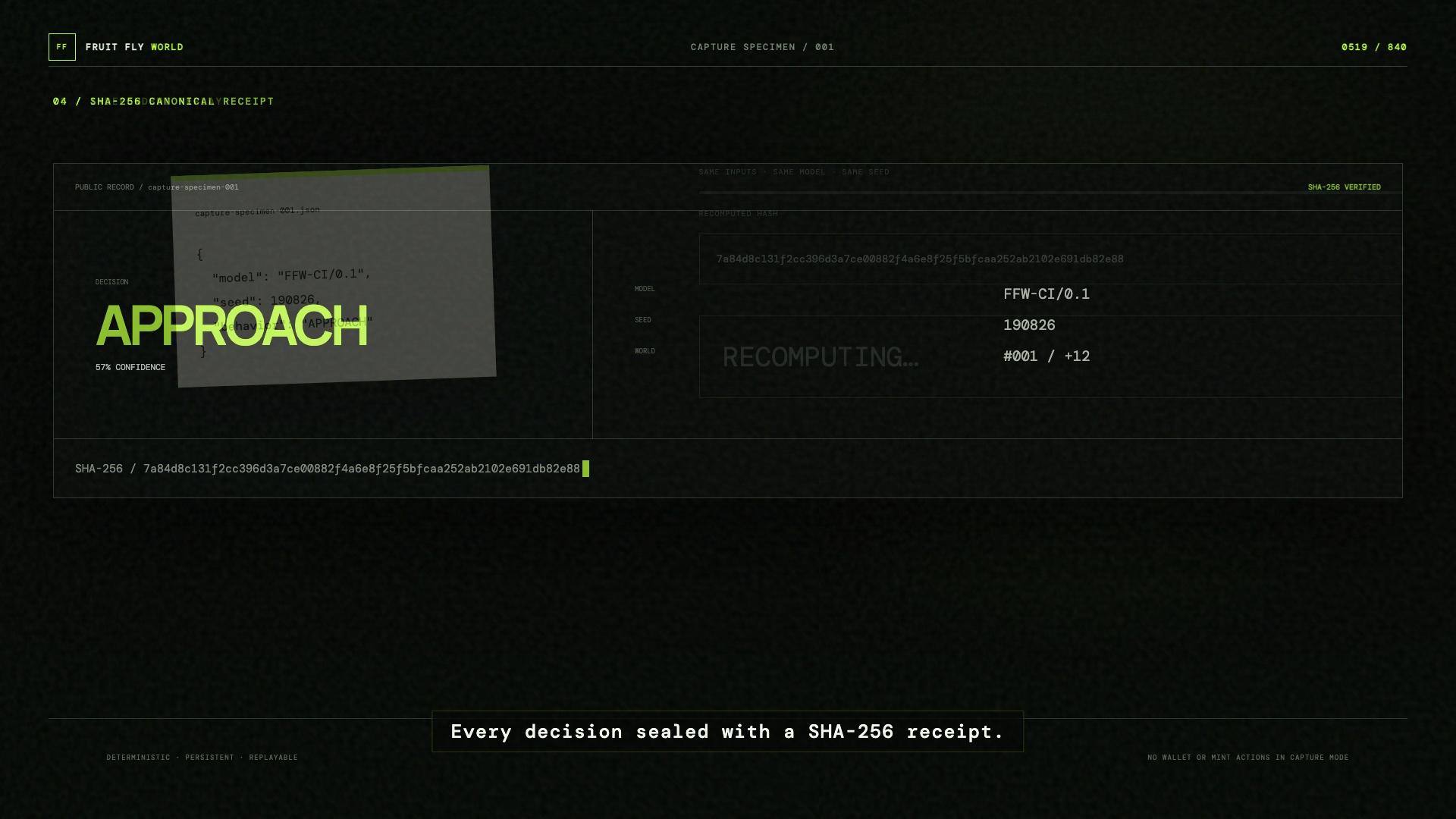
This is the part you can check without trusting us. Run the same loomings against the real connectivity and against a version with the two channel weights swapped, and see whether the channel order is doing any work. It is a simplified two-channel assay, not an experiment on the connectome.
1337
Every trial starts from the same seed, so the run is the same run for everyone who repeats it.
200
Real connectivity against swapped connectivity, same seeds, same loomings, same predator.
100% vs 68%
Real connectivity escapes 100% of the time with 0.202 s of lead; swapped escapes 68% with 0.183 s. A simplified two-channel assay: the gap says channel order matters in this circuit.
RUN IT YOURSELF — The experiment is reachable from the game menu, and the simulation module is plain JavaScript with no build step. Change the seed and the numbers move; keep it and they reproduce exactly.
04 · THE LINEAGEDeath ends a generation.
Death ends a generation.
Not the run.
You are not a fly, you are a lineage. Eggs are the score, mutations are the upgrade, and the wild type is the thing you are trying to outproduce.
VS WILD TYPE
Energy converts to eggs on its own. The generation is scored by how far ahead of the wild type it finished.
3 → 1
Three cards, one choice. Twenty-four mutations exist across the pool, and the one you take changes how the next generation plays.
LOCAL
The lineage is written to your browser only. Death ends a generation — it does not end the run.
05 · HONEST SCOPEInspired by a circuit.
Inspired by a circuit.
Not a complete brain.
The game uses research-informed names as design references. Saying exactly what it is not is part of the design, not a disclaimer bolted on afterwards.
A MODEL
A simplified, connectome-inspired escape circuit, plus a game built on top of it.
NOT A BRAIN
Not a complete fruit-fly brain, not a full FlyWire or MaleCNS runtime, and not a neuron-by-neuron simulation.
RUN IT
The wiring check ships with the game: same seed, real connectivity versus swapped, and the numbers are reproducible.